Monday, August 10, 2015

A Capitol Obsession, Part 4


(continued...)

Gosh it has been so long since I've been to a new capitol.  I've been waiting to collect six new visits to post the next installment.  After recent trip out west I'm able to publish the fourth installment here.


Cheyenne, Wyoming

Date: August, 2015

Building: Renaissance Revival style. Built 1886.  Sandstone.  Dome: Gold. No dome statue.  David W. Gibbs and Co., Architect.

Trivia:  This isn't trivia so much, as backstory that informs this blog, as my NOT visiting Cheyenne for so many years may actually be responsible for my determination to visit capitol buildings. Back in 1974, our family took a crazy rushed camping trip to California and back.  Our vacations were not for relaxation, but rather for seeing places of significance.  So we visited many, many National Parks and sites throughout the West. I was still in grade school at the time so I don't really know that much about how decisions about our destinations were made, but I suspect that my Mom was responsible for our stopping at capitol buildings, a habit I'm sure I was very happy to follow her in.  To my memory, on this trip we had already stopped at capitols in Oklahoma, New Mexico, Nevada, California, and Utah. We were in a huge hurry to get home so Dad could teach, and our VW bus was having serious issues (so serious that in Sacramento, the only way we could get going was to have a motorcycle gang push us as Dad popped the clutch), and I think the rest of the family was much more ready for the "vacation" to be done than I was.  Anyway, we were tearing across southern Wyoming, and I was living in expectation of stopping in Cheyenne.  But my brother, John, was at the wheel and refused to pull off the highway...and whether real or dreamed up, the memory of speeding past Cheyenne, helpless to see the Capitol, was seeded into my brain.  So at last, 31 years later, I made it.

Comment:  The building seems really tiny.  Maybe it's just that Cheyenne itself is such a small place. Or maybe it just seems small in comparison to Kansas' and Colorado's buildings that I had just seen.  But it is one of the sweetest settings.  There are two great statues that you pass on entering: one of a Native American Chief (the rendering of the headdress is really fantastic) and the other is of a very determined woman who was instrumental in bringing statehood to Wyoming Territory.  Inside, the building is sort of miniature, as suits the exterior.  The rotunda is quite small; interior decoration is mostly carved wood (unlike most other buildings that feature exotic stone). There are some really beautiful stained glass skylights in the legislative chambers and in the top of the dome.  I like this place a lot, but it gives the feeling more of a very nice courthouse than of a state capitol.

Rating: 


------

Topeka, Kansas

Date: August 2015

Building: French Femaossamce. Built 1866.  Limestone.  Dome: Copper. Statue:  Ad Astra. Edward Townsend Mix, Architect.

Trivia:  In 1898, Jerome Fedeli painted frescos near the top of the dome in the rotunda. Fiddle's work depicted bare-breasted classical women. However, officials referred to the paintings as "Nude Telephone Girls" and had them painted over. I guess things haven't really changed that much in Kansas.  The interior is decorated throughout with murals depicting significant events in Kansas history. 

Comment:  It is clear that Kansas has recently spent LOTS of money restoring the building. It is is in perfect condition. It is an imposing building, but leaves one inside and out with a feeling that something is wanting...I'm not sure what.  The renovations created a huge visitor's center buried under the back plaza and steps; it's all very nice, but it creates a huge sense of separation from entering the building the way it was intended to be approached and so I think it destroys much of the feeling of grandeur you expect when you look at it from a distance.  Topeka is a very sparse city, it seems and so the building seems to sit in a no man's land with too much space around it. I don't know why I feel so unmoved by this building, as there's nothing really wrong with it.

One thing that would be very cool to do if one has the time, is that they let visitors climb to the top of the dome.  Will need to think about planning to do that in the future.

Rating: 

------

Columbus, Ohio

Date: March 2015

Building: Greek Revival style. Built 1839-1861.  Limestone.  Dome: Limestone drum.  Architect Henry Walter based on design elements by Thomas Cole.

Trivia:  This is one of the few state capitols that owes virtually nothing to the US Capitol for inspiration, as it was designed before the famous elements of the US Capitol were added. The building was constructed over the course of 22 years because of a number of problems: objections to using prisoners from the State Penitentiary rather than skilled craftsmen for the laying of the foundations, disagreement about which of three designs were chosen, expiration of the act that specified Columbus as the capital, interruptions caused by the Civil War, and discovery late in the construction that no accommodation had been made for heating the building. 

Comment: It is said that this is one of the very best examples of Greek Revival Civic architecture in the US.  Judged on that basis, it really is quite a beautiful building in its geometric simplicity.  It shares many characteristics of the much smaller old Illinois Statehouse in Springfield.  As much as I try, though, I can't ever feel quite comfortable with that drum on top that seems to be begging for a dome. The building has undergone a complete refurbishment recently and everything is in perfect condition. (The entry and visitor's center are all deep in the crypt, so you get to see a lot of the massive walls and arches that support the structure.  Inside, there's a lot of wood carving and classical ornamentation...again, quite nice as an example of this period.  I have to say, though that it seems a little too austere to my taste.  One of the very best things, though, is a veterans monument on the grounds that reproduces (etched in stone) actual handwritten letters sent home from service men in combat.  It's very hard to experience and not be moved to tears by the hope and innocence.

Rating: 


------

Boston, Massachusetts

Date: March 2013

Building: Georgian style. Built 1713.  Brick.  Spire: Wood. Roof figures:  7-ft Unicorn and Lion, representing the English monarchy. Architect unknown (possibly Francis Twelves).

Trivia:  Served as house of Boston government until 1798.  Site of much significant legislative activity during the colonial and revolutionary periods.  The Boston Massacre took place right outside this building.  This was a multi-use building housing several disparate entities, but the government spaces were on the top floor. A notable feature of the Legislative Chamber was that it was built to include a public gallery--the first such space in the English speaking world to do so.  The building currently serves as a museum and home for the Bostonian Society.  

Comment:  It's a decent Colonial structure whose setting makes it nearly impossible to get a good view or actually appreciate it.  It seems to be a building with extreme historical significance that doesn't have much else to recommend it on its own.  I always find it a little disconcerting that you enter this historic landmark and find a Metro stop in the basement.

Rating: 


------


Providence, Rhode Island


Date: March 2013

Building: Neoclassical style. Completed in 1904.  Georgia marble.  Dome: Marble. Statue:  Independent Man. McKim, Mead, and White, architects.

Trivia:  One of the last capitol buildings built in the US in traditional classical style. The statue of Independent Man was originally to be of Roger Williams, founder of Providence Plantations, until it was discovered that there is no existing likeness of Roger Williams, so impossible to know what he looked like. It's odd that some still claim that, since this version of "Independent Man" seems to be wearing a loin cloth.  

Comment:  At first glance, the building has everything going for it:  lovely hill-top setting with commanding view of the town, clean monumental classical lines, a beautiful white marble facade, and striking dome.  But there something about it that ultimately makes it fall short.  Perhaps it is the extreme blockiness of the base of the building that doesn't transition gracefully into the dome.  I wonder if the colonnaded drum of the dome perhaps is too tall for the other proportions of the building  I also fear the four domed-turrets get in the way.

My Rhode Island State House experience is notable, though, for what happened inside.  There was really no information desk or welcome place of any sort to help the visitor, so I pretty much had to just roam around aimlessly feeling more like a loitering hooligan than a valued guest.  Finally I met a youngish woman passing through a corridor and asked her if there wasn't a visitor desk.  Her reply:  "No, I'm sorry.  We're still working on that."  Note that the building was completed more than a hundred years earlier.  If it isn't done in 109 years, you can't say "we're working on it" anymore.  You've given up.  It just seemed like the most preposterous reply ever.
.

Rating:


-----

Richmond, Virginia


Date: March 2013

Building: Palladian style. Completed in 1785.  Stucco.  Dome: Internal. Statue:  George Washington (in Rotunda). Thomas Jefferson, architect.

Trivia:  One of the first prominent buildings to reject the Georgian style popular in England, and so in some ways, this was Jefferson's declaration of independence in the architectural arena.

Comment:  This is a lovely building.  (Unfortunately, it was closed so I couldn't go in; I'd been in 20 years ago or so, but it has been extensively restored since then.) It captures a sense of the importance of government without making the citizen seem insignificant.  It is on an enormous hill so the prospect from approaching it makes it look exceptionally picturesque just from the perspective looking up at it.  It's not a very big building so it is certainly understandable that additions had to be made, but I find the two wings really distracting. Someone attempted to make them of a coordinating style, but they really look like additions to me.

Rating:


Monday, June 3, 2013

Another Great Art Museum

Rear entrance to Dallas Museum of Art
I had the misfortune to have to spend nearly a week in Dallas, TX, but had the good luck to sneak about 30 minutes for a hasty visit to the Dallas Museum of Art.  I approached the generic concrete buildingwith little enthusiasm; frankly, it looked more like a parking garage than any other useful structure .  The last "big" art museum I'd visited was the High Museum of Art in Atlanta, which was a major disappointment (it didn't even warrant a mention here), and I was disheartened to first re-encounter here a Victorian marble statue of the ilk with which the High Museum was overpopulated, for fear that I would have the same disappointment here.  I was further distressed that the museum guide brochure presented the most useless and confusing map of any galleries I've ever seen.  Knowing I only had about 30 minutes before the museum was slated to close, I attempted a mad dash for the American and European galleries which are my most favorite areas in most art museums.

I was so delighted on finally getting to the American galleries to find myself absolutely enchanted by the collection--some wonderful paintings, often by painters with whom I was for the most part unfamiliar.  Here is a sampling of the works I found so wonderful:

Thomas Sully
Cinderella at the Kitchen Fire (1843)


Perhaps it is just the fondness I now have for cats, but the sweet playfulness of this Cinderella with this frisky cat contrasted with the fierce determination of the glimpse of the step-sisters in the next room preparing for the ball is irresistible.  Not sure why this appealed to me so much, as its muted palette and relative plain treatment seems sparse compared to what I often am attracted to.  Perhaps it is because this Cinderella has a look similar to Lesley Ann Warren, who's Cinderella in the 1960s TV version is a performance of which I am particularly fond.


Thomas Eakins
Miss Gertrude Murray (1895)


The half-beautiful, half-awkward depiction of this woman is so like Eakins portraits that seem to not balk at revealing the flaws or perhaps more accurately the imperfections of his subjects.  Knowing what a master of depiction of detail he was, you know that he intended for this awkward or shy nature to be prominent in this portrait.  Points off for the gown texture, though; the representation of the silk gown isn't convincing.


Cecilia Beaux
At the Piano (c. 1890)


Have never heard of Cecilia Beaux, but I like the sketchy, skewed perspective of this scene immensely.  I love this kind of color blocking; I don't know if that's the right description, but I'm referring to the way the shadows on his suit are shown with distinct color blocks with relatively little shading to transition between colors.  It gives the slight suggestion of the feeling one gets from a paint-by-number work (the good aspects).  The commentary states that this was most likely used as the illustration for an article in magazine...which only makes me want to find that story!  I don't know why, but it immediately suggested The Gift of the Magi to me even though I can't remember that there was anything at all about a piano in that story.


John Singer Sargent
Dorothy (1900)


Like all Sargent portraits, I'm astounded by the impression of accuracy of depiction of life, reality of light, and fidelity to textures created on first glance, but then is betrayed when the image is examined closely.  At close range a stroke of an unexpected color seems out of place, but moving back even a very short distance, the discordant element is often the thing that makes the image pop out as being so real.


Frank Duveneck
Lady With a Red Hat (Portrait of Maggie Wilson) (c. 1904)


Another artist unfamiliar to me. Again, I am dumbfounded by the use of color to depict light.  There is evidence that this was created as a demonstration work for his students...to demonstrate expert brushwork.  It's pretty great for something done on the fly as some sort of a demo.


John White Alexander
Miss Dorothy Quincy Roosevelt, later Mrs. Langdon Geer (1901-1902)


This portrait is quite large and at first glance I took it almost for a Whistler.  The muted palette, the exaggerated tallness, the small elements that mildly question tradition all had that feel.  I should be more familiar with John Alexander than I am, as I'm sure I have encountered some of his other works elsewhere. I like how this pose (and the presence of the sleeping dog) suggests a lack of interest in the sitting and more of a moment of contemplation.  The subject was Theodore Roosevelt's cousin.


Jerry Bywaters
Share Cropper (1937)


I love this portrait as well, but I wanted to make sure to post it to prove that I'm not completely buried in only the late 19th Century aesthetic.  Yet again, I was unfamiliar with Bywaters, but the significance of his work in Texas is impossible to overstate, it seems.  I guess he shares much with another regional painter of the era, Grant Wood, although this seems a lot more modern somehow.


Those were the highlights of the American Collection.  After spending far too little time there, I made several unsuccessful efforts to find the European galleries, before stumbling there for a few minutes before the looming closing.  The European stuff was less exhilarating, but in the middle of the paintings was a really interesting display about Genre, and how the perceived importance of various genres changes with time.  The embarrassing bit (embarrassing because damning evidence of my low tastes are documented in this very blog) is that for centuries, portrait painting was the lowest form of painting--because it was viewed as such a selfish endeavor when compared to the virtue of illustrating an allegorical tale or religious scene.  I'm glad this perception has changed nowadays or most of my enjoyment in art museums would be prevented.

Finally, just to include at least one non-portrait, I submit this lovely scene.

Emile Bernard
Breton Women Attending a Pardon (1892)


I still find it surprising that this painting was done in 1892.  the flat elements and the unconventional colors make it seem quite modern, but the subject of the Breton women engaged in a very old-fashioned ritual provides a really cool contrast for both the strictly visual effect and also the perceived mood of the event.


So there you have it...I very dodgy and quick excursion into the Dallas Museum of Art.  Having entered with very low expectations, I think it is fair to now rank this collection and museum experience in the top tier of Art Museums I've visited.  I'm so happy I took the time to explore even a little bit.

Wednesday, March 20, 2013

Avenue of Forgotten Famous People

I was speaking at a conference at the Hynes Convention Center in Boston, but since I was staying in a hotel downtown I took various methods to go back and forth, including walking the length of Commonwealth Avenue, which is a beautiful avenue lined with late 19th Century townhouses and with a grassy boulevard park down the middle.  In each block is a sculpture and so I decided to track the statues, west to east.  What was most significant about this task was that most of the honorees were completely unknown to me.  Now the degree to which that is a function of my own ignorance is certainly up for debate, but it struck me as both sad and wonderful that these people were commemorated.


Domingo F. Sarmiento


Domingo F. Sarmiento looking grumpy
The first statue is of Domingo F. Sarmiento, a 19th Century president of Argentina.  It isn't at all clear what his connection to Boston might be, but the sculpture wasn't placed until 1973, a gift from the government of Argentina.

It appears he was quite the champion of education.  The sculpture is really fine, but it is odd how the markedly twentieth century sculptural style makes it so difficult to imagine this man as a 1850s political figure.


Boston Women's Memorial -- Lucy Stone, Abigail Adams, Phillis Wheatley


Three famous women ready to make a break for it.
In the next block was a rather interesting sculptural group honoring three significant women in Boston (and US) history.  It really is one of the oddest (not necessarily bad) sculptural pieces I've encountered  The three women are cast in bronze, each attached to a granite slab, but the figures are life-sized and are beside rather than atop their pedestals, giving the impression that they have come to life and are just sort of hanging out, waiting for a chance to make a getaway.  It was placed in 2003, and even though the bronze castings are very traditional, they still have a very modern feel.

Lucy Stone was probably the first to really take up the issue of women's rights in the United States, with her writings inspiring the activities of Susan B Anthony, Elizabeth Cady Stanton, and the more famous advocates of women's rights that followed after her.  Lucy Stone was a staunch abolitionist and was also the first woman recorded to keep her own name after marriage.

Abigail Adams giving me a "Oh no you di'nt!" stare.
Phillis Wheatley was the first African American poet and the first African American woman to publish a book.  Details are a little sketchy, but she was born in West Africa and sold to a wealthy Boston family, the Wheatleys.  Her first name was chosen by her mistress from the name of the ship that brought her to the U.S.  These facts are really so disturbing to think about a human being treated that way.  She died, in slavery, at the age of 31.

And Abigail Adams, of course is the famous wife and partner of John Adams.  I have to say that her depiction here has her dishing out a lot more sass than I ever imagined her doing.


Samuel Eliot Morison


Samuel Morison sporting a super casual look.
In the next block was another fellow of whom I'd never heard before.  The sculpture suggested someone with an affinity for the sea and storytelling.  There was a quote that included tons of archaic spelling (i.e., abounde, etc.) that made me think he was probably a little full of himself if he was actually a writer.  It turns out he was a Rear Admiral in the US Navy Reserve, and known for his books about maritime history that were (according to Wikipedia) "authoritative and highly readable."  I hope that's correct, as the quote on the base did not strike me as highly readable.  And he earned 11 honorary doctoral degrees.  I ought to want to look up what he wrote and read it, but sadly, I don't.


William Lloyd Garrison


Lloyd Garrison kicking back after delivery a fiery anti-slavery rant
Next block, another unknown man:  William Lloyd Garrison.  (And by the way, why does "Lloyd" need two "L's"?)  Very nice, seated figure, but not a clue as to who he is...so Wikipedia must come to the rescue once again.  Seems like he was a pretty great guy...a tireless advocate for the abolitionist cause and was the editor of the abolitionist newspaper The Liberator.  In Wikipedia's eclectic style, we also learn that he sold lemonade and homemade candy as a child.  He was an advocate for immediate and complete emancipation which put him at odds with many others in the abolitionist cause that preferred a gradual emancipation.  He caused a great stir when he burned the US Constitution publicly on July 4, 1854, claiming it was "a Covenant with Death, an Agreement with Hell," because of the way it coded slavery into the founding philosophy of the US. Apparently Frederick Douglass felt that you could still read the Constitution as an anti-slavery document, and as a result the two leaders had a major falling out. This doesn't explain why there are two "L's", but Lloyd was his mother's maiden name and she insisted that he go by it. I suppose Lloyd must be Welsh.

Patrick Andrew Collins


And in the next block I encounter a monument to is another famous person I've never heard of.  Collins was born in Ireland, moved with his family to Massachusetts, was a successful upholsterer, went to Harvard Law School, and then led an extensive life as a Massachusetts politician, ultimately serving as Mayor of Boston for the last 4 years of his life.  I feel somewhat vindicated in knowing nothing about him.  The sculpture is just a bust on a very tall plinth, flanked by two female allegorical figures.  The figures are lovely, but they are so "allegorical" that I couldn't really figure out anything specific that they represented.


John Glover of Marblehead


John Glover being nostalgic about his days as a cordwainer
In the next block, in spite of being forgotten, John Glover cuts by far the most dashing profile on the boulevard.  I'm sorry the light was such and the iPhone camera is so crude that it didn't capture a better image of this statue.  It really is terrific.  Glover was a businessman and fisherman from Marblehead, MA, who became a general of military significance during the American Revolution.  I'm sort of surprised that I have never heard his name before, as it seems that he was instrumental in several campaigns during the war.  I know, that in general, I've read more about the American Revolution than most people, so I figure there is widespread ignorance of his contributions.  It makes me wonder what is even taught anymore in our schools about any details of the American Revolution.  It seems that it may be so far off the measure of "significance" that it doesn't matter, as whenever people complain about what kids don't know, the American Revolution seems so remote that it isn't even on the radar as something that people don't know enough about.

Alexander Hamilton


Alexander Hamilton caught by surprise.
I get to the last block before reaching Arlington Street and the Public Garden and find this tribute to Alexander Hamilton.  Ok, so he's famous.  it's a strange statue, though, and the only one in the sequence that isn't bronze, and seems sadly out of place.  And in an effort to give it some classic toga-like reference, Alex is depicted with a robe loosely slung around his lower half.  It looks most like one of those scenes from a movie where someone in bed has to get up in a hurry, and instead of getting dressed just rips the sheets off the bed and wraps them up loosely to conceal any nakedness...which is doubly sort of odd here in that the figure is fully dressed.


So that sort of ends the tour, except for two sculptures not strictly on Commonwealth Avenue but part of this tour.

Washington on his steed.
First an equestrian statue of George Washington in the Boston Public Garden.  I don't really know anything about it, but in general, it is a lot more satisfying than either of the two Washington equestrian statues I saw in Washington, D.C.


Preachers used to have really great robes.
And then finally, a monument I like to visit every trip to Boston simply because I love the inscription so much.  The statue is of William Ellery Channing, one of the foremost Unitarian ministers and much involved in the transcendentalist movement of the 19th Century.  The statue looks directly across Arlington St and the Arlington Street Church which, though a Unitarian Church, is not where he actually preached.

The inscription:

I see the mark of God in the heavens and the earth, but how much more in a liberal intellect, in magnanimity, in unconquerable rectitude, in a philanthropy which forgives every wrong and never despairs of the cause of Christ and human virtue.  I do and I must reverence human nature.  I bless it for its kind affections, honor it for its achievements in science and in art and still more for its examples of heroic and saintly virtue. These are marks of a divine origin and the pledges of a celestial inheritance, and I thank God that my own lot is bound up with that of the human race.


What this exercise reinforced in me is a simple message, yet one that bears reinforcement.  It matters little what lasting fame one achieves, but rather that we have an impact on those we come in contact with, no matter how great or limited that sphere of influence.


Wednesday, March 6, 2013

Cats of Great Britain

Tonight I was engaged in the seemingly endless task of sorting and organizing photos in iPhoto and noticed something that makes me smile.  Over the course of three different trips to England, I'd collected, quite accidentally, the images of three sweet cats, each coupled with a magnificent landmark.

Red House, Bexleyheath
My first excursion was an add-on to a work trip I was fortunate to take to Oxford in 2006.  After my working sessions I traveled a bit around the country, ending in London and spending one day on an excursion to see the Cathedral in Rochester.  On the way I got off the train and  visited Red House in Bexleyheath, the house William Morris had designed and built as the ideal home from which the arts and crafts so cherished by the Pre-Raphaelites might flourish.  Bexleyheath is now a typical commuter suburb of London with streets filled with expected London terraces, but when this magnificent house was built,  it sat amongst orchards and fields.  The Morrises and their compatriots actually only were able to live here for five years before financial difficulties forced them to sell.  William Morris never returned as he felt it would break his heart to see it again.  Edmond Bourne Jones claimed this was the most beautiful spot on earth, a claim I'm not prepared to argue against.

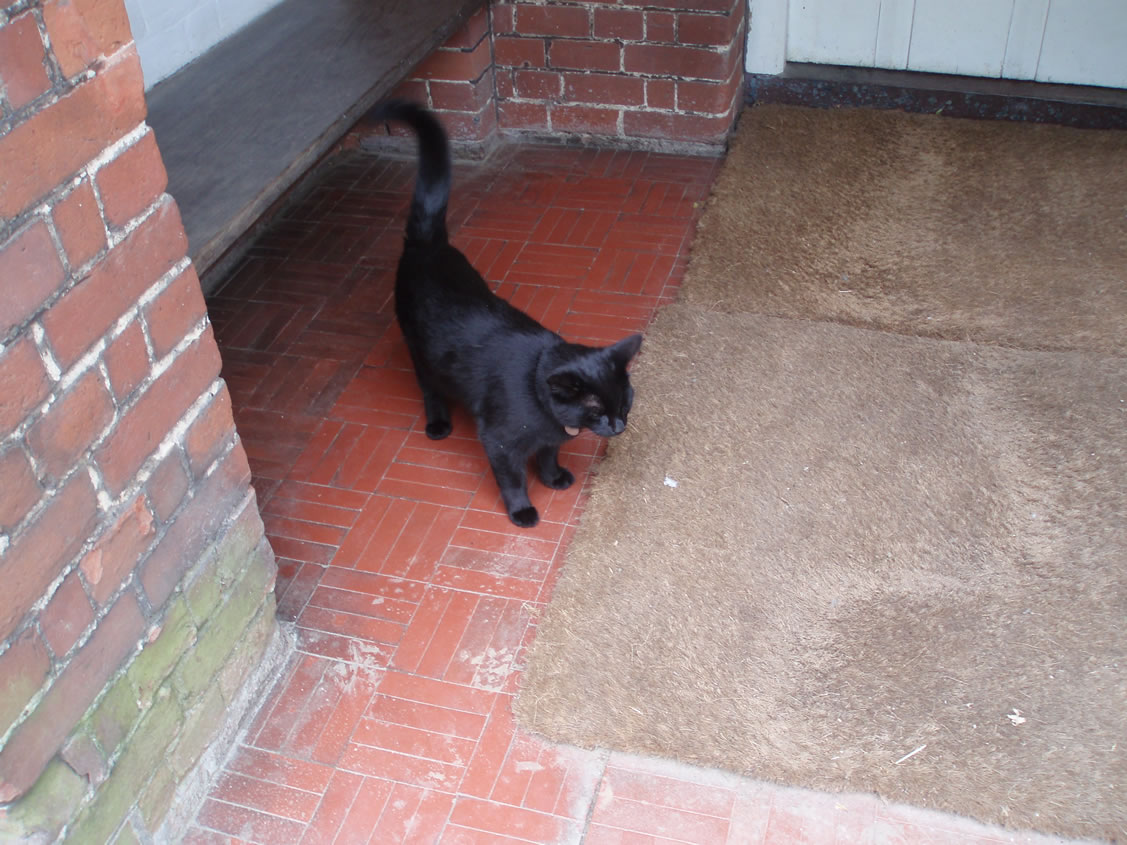
Red House Cat
As I waited in the lovely gardens for my tour time to arrive I made friends with this charming black cat who seemed quite at home here.  He was collared with a dainty little bell. He sat and observed the guests, hid amongst the flowers, crept into the open potting shed, and snuck into the gift shop as a patron was exiting.  I have seen cats in bookstores in the United States but that's about the only public place I've come across them.  (Note, I've not been to the Hemmingway House in Key West which is a prominent exception to that statement, I gather.)  It provided such a welcome and oddly human touch to be aware of the presence of this cat.  I'm not sure why I was actually motivated to capture him on film, but there it is.

St Albans Cathedral, 11th Century tower
Just a few months after this I was fortunate to have another trip to England, this time for several days for meetings in a country manor-turned-hotel just outside of Basingstoke.  Again, I was agressive about taking advantage of being in England and took several excursions.  My favorite ever was a late night train ride (thank heavens for unlimited ride train passes) to Oxford for a cone of Turkish Delight ice cream.  But I was also able to take a circuit up a little north of London to several historic sites, including St. Albans Cathedral.  St. Albans was an ancient monastic site, turned to a parish church after Henry VIII's dissolution of the monasteries, but then elevated to the Cathedral for the Hertfordshire region in 1877.  So while it is an ancient building, it is not an ancient cathedral  per se.  It does make claim to two records:  that it is the oldest spot of continuous Christian worship in Britain, and that it has the longest nave of any Cathedral in Britain.

St. Alban's Cathedral Cat
It also has (or at least had when I was visiting) this delightful cat living in the Cathedral Close.  He was lounging under a chestnut tree but then arose, trotted over to the south transept of the cathedral and scampered into the Monk's door.  He was speckled with tans and browns and blacks and with white feet.  He was a good match for the irregular substance of the cathedral, which unlike most other grand churches that are built of uniform stone, is constructed of smallish pieces of the local flint and ancient brick salvaged from the ancient Roman city of Verulamium upon which present day St. Albans is built.
Exeter Cathedral

It was two years later that I took my last (so far) trip to England.  This time I was to conduct some training at the HSBC training center which happened to be at a re-used 19th century manor that is just outside of St. Albans.  But this time, I took two days before my business was to start to explore Exeter.  (I know, Exeter is in Devon, nowhere near St. Albans). I didn't know that much about Exeter before, but I have to say it is absolutely one of my favorite spots in England. Perhaps I will write about my adventures here in another entry, but of course my reason for going to Exeter was to visit Exeter Cathedral.  This was an exciting visit as with this trip, I knocked of one more targeted destinations so that the Cathedral in Chester is the only medieval Cathedral building in England I haven't yet visited.  (And to be completely honest, I have to admit I have not actually been inside Lichfield Cathedral, even though I was on the grounds...stupid closing hours....)  Exeter Cathedral is not particularly distinguished by size or height or imposing design, yet it is perhaps the most pleasingly comfortable and remarkable of all the cathedrals I've visited.  Its close is idyllic yet full of life.  It does have the distinction of having the longest unbroken Gothic vaulted ceiling in the world, by virtue of the fact that the two original Norman towers flanking the middle of the church made a central tower impossible, an arrangement unique in England...so the arcading marches down the full length of the nave and joins continuously with the vaults over the choir.

Exeter Cathedral Cat
But the significance of Exeter for purpose of this article is that once again, as I sat on the lawn in front of the cathedral enjoying Marks and Spencer take-out, I was joined by this lovely cathedral cat--as surely part of the fabric and maintenance of this building as much as the Dean and Precentor and canons, deacons, and vergers who sing and pray and support this institution ever were.  It is mind-boggling to think about this places of worship where Evensong has been sung everyday for 900 years.  It is equally impressive and again, oddly humanizing, to think that there probably has been a cat or two, here in the close, sneaking into the cathedral and the crypts, catching mice and frolicking here in the grass amongst resting pilgrims for 900 years as well.

Ratings:
Red House


St Albans Cathedral 


Exeter Cathedral


Tuesday, March 5, 2013

An Afternoon in an Art Gallery

I've had the pleasure of being able to visit some small art museums in some of my recent trips, and was struck with how much more satisfying these little gems are than some of their bigger, more famous counterparts.  (As a disclaimer, note that I claim no particular expertise or formal study of art or art history and so my knowledge is entirely what can be gleaned from museum visits and keeping one's eyes open in general.)  The Frick Collection in Manhattan is probably the most famous and the one actually loaded with world class masterpieces (the Holbeins and the Vermeers), but the Isabella Stewart Gardner Museum in Boston, the Palace of the Legion of Honor in San Francisco, and the Kimbell Art Museum in Fort Worth all provide wonderfully unique perspectives into the art world, all of which I highly recommend.
  
But the biggest surprise was the discovery of the Frye Art Museum in Seattle.  I just  happened to hear about it in passing and am so happy to have spent a couple hours there.  The museum is in a modern building in Seattle's First Hill neighborhood.  Charles Frye made a fortune in meatpacking, collected a lot of European (particularly German) paintings, attempted to give his collection to the city but was rebuffed in some way by another collector's bounty which became the Seattle Art Museum, and so subsequently created this independent gallery.  The wonderful thing about museums like this that are rooted in a single individual's tastes is that you get a window into styles of art that you don't necessarily find in such concentration elsewhere.  The Fryes seemed to have a real passion for the 19th century pastoral, the romantic, the bucolic representation of people and settings that feels really old school compared to the impressionistic movement.

At first, the collection seemed to be perfectly charming portraits like this Shepherdess by Adolph Bouguereau.  My photos from my iPhone don't really do these works justice.  I'm not really familiar with Bouguereau but it seems he had quite a following before falling out of favor in the early 20th century because of the realism of his painting.

What was more interesting, though, was the large number of 19th Century German paintings that were in the collection.  Perhaps I just haven't been paying attention, but it seems like one rarely sees paintings from Germany in many museums.  A favorite painter of the Fryes seems to be Gabriel von Max.  Here is his Madonna and Child from 1905.  I know so little about art history that I am really reluctant to make any comment at all, but this portrait fascinates me in what it succeeds at and what it fails to do.  The mother seems so completely ordinary, which perhaps is the intent.  It seems that Dutch versions of this would have portrayed an intensity and reserved emotion; Italians would have given more grace and idealized beauty; French would have been more alluring.  This is just a young girl with a baby you might find shopping at Aldis.  I don't mean that despairingly, as this portrait has really grown on me.

Another German artist with whom I was completely unfamiliar was Heinrich von Zügel. This painting, Shepherd and Flock, must be pretty representative of his work as he seems to be recognized primarily as a painter of cattle and sheep (of which there were several examples here).  Again, I'm sorry that this image is so poor, as the textures and the facial depictions of the sheep are so evocative of remembrances of the little exposure I've had with sheep.  You can feel that gentle warmth of that wool nudging against your thighs if you were that shepherd.  Well done, Heinrich!

What added to the delight of meandering through the galleries was that there was a string quartet from the Seattle Youth Symphony playing.  There were chairs set up, but the size of the galleries and the central location of the quartet made it possible to hear the music throughout the entire museum.  They were playing Mozart and Haydn, which was pleasant enough, but then they switched over to playing the Borodin string quartet...the slightly anachronistic romantic nature of which seemed ideal for the old fashioned art I was viewing. (Click here to listen to Borodin while you continue).

But the real delight came in the final gallery (or perhaps I was going in reverse order and this was meant to be the first gallery).  It was a small room, not much bigger than my bedroom, really, and on each wall hung a single large painting.  To the north was the largest, Sainte Genevieve (1887) by Charles Sprague Pearce.  For a painting 125  years old, the young girl depicted here looks radically contemporary--her face and features and even the textiles of her clothing make her someone you would not at all be surprised to see hanging out in a campus coffee shop...carrying off a little of a disaffected hipster air with brilliance.  The painting (as all four in this gallery) is something over 8 feet tall, I'd guess.  The cattle, unfortunately, are not nearly as convincing or appealing as von Zügel's sheep.

Turning to the east, one is confronted with a lovely John Singer Sargent full length portrait--this one of Mrs. Frederick William Roller (1894).  This enormous portrait has all the hallmarks of a great Sargent portrait..the thoughtful countenance, the liveliness of the highlights in the eyes and hair that make it seem like the person might speak or move at any moment.  Unlike so many other of Sargent portraits, it seems little intent was to impress with the wealth or extravagance of the sitter.  The gown, I'm sure is opulent, but is painted to downplay its luxury rather than the reverse.  Very restrained but not uncomfortably so.


And then we turn to the south and find this enormous backwards portrait by John White Alexander:  Woman in Black (1896).  This was an artist whose name I didn't recognize at first, but after some research remembered being struck by a painting of his in the Boston Museum of Fine Arts a few years ago (Isabella and the Pot of Basil).  I found this portrait so unusual in that it shows so little of the woman...essentially nothing but a fraction of her cheek and a hand, yet the book, her sweeping hair, the folds of the fabric in her dress, her slouching pose create such a vivid picture of who this woman is, what captivates her, and what might she be lost in thought about in her reading.  I love portraits that suggest thoughts about what is not shown as much as what is illustrated on the surface.

And finally, turning to the west and seeing yet another enormous portrait on the fourth wall is almost overwhelming.  This fourth is Portrait of a Lady against Pink Ground (Miss Virginia Gerson) (1886) by William Merritt Chase.  This portrait seems uncharacteristically misty compared to his other paintings with which I'm familiar.  The pastel nature and the slightness of the detail made me assume this was somethng by Whistler before I read the information placard.  But if it were a Whistler, even the pale pink probably would be more vivid color than he would have included.

At any rate, it was fascinating to view these four portraits that were painted within 10 years of each other...in some ways so similar and in others not a like at all.

These are the excursions that make me love museums.  Highly recommended if you ever find yourself in Seattle with an hour or so to fill.

Rating: